
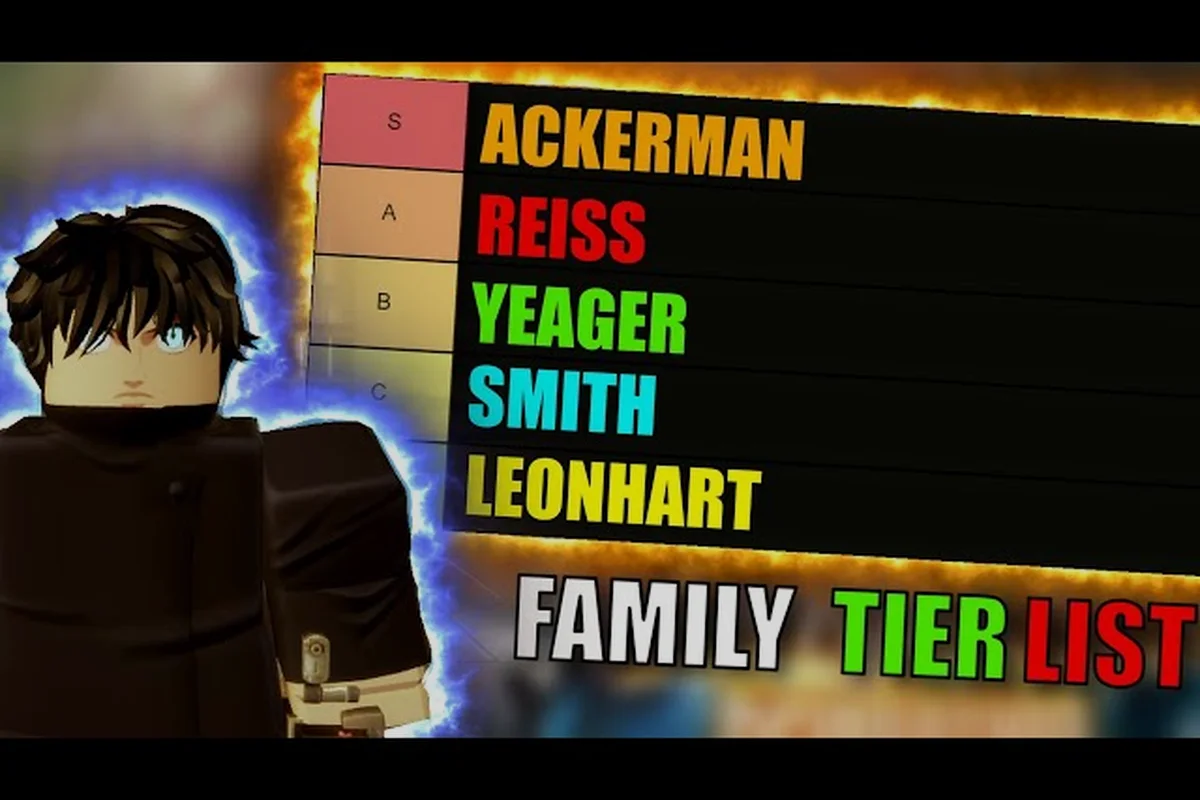
Family Tier List and Rankings
The Attack on Titan Revolution family tier list matters because each clan adds a passive identity that changes how your perks, stats, and combat habits work. Use this guide to compare every known family, identify the strongest overall picks, and decide which results justify an Attack on Titan Revolution family reroll.
Complete Attack on Titan Revolution Clan List
The full Attack on Titan Revolution all families list places each known clan into a practical tier. The game’s the official game listing on Roblox describes families as a rarity layer equipped separately from perks and memories, so a family’s value comes from both its passive identity and the build layered over it.
This ranking weighs each family passive against the stats and weapons it supports, rather than treating rarity as an automatic verdict. For example, an attack-focused build may favor a family that strengthens damage or crit potential, while a speed or support setup can benefit more from stat-oriented bonuses. Because families, perks, and memories are equipped separately, an A-tier passive can outperform an S-tier family when its bonuses match your build; families within the same tier are therefore situational, and rerolling is worthwhile only when the new passive fills a clear gap in your current stats.
| Tier | Families | General assessment | Best use |
|---|---|---|---|
| S | Yeager, Fritz, Helos | Exceptional ceiling and standout passives | High-value accounts and optimized builds |
| A | Ackerman, Reiss, Shiki | Strong combat identities with useful scaling | General progression and advanced play |
| B | Credence, Fritz-related alternatives, strong common clans | Reliable but less distinctive | Balanced early-to-midgame builds |
| C | Assorted lower-rarity families | Functional bonuses with narrower value | Filler builds and temporary roster slots |
| D | Weakest early families | Limited impact or awkward scaling | Reroll targets when resources allow |
Top-tier families
Yeager belongs at the top because players consistently treat it as a marquee family result. According to community reports, its pull rate is roughly 0.1%, although that figure has not appeared in an official probability table. That combination of rarity and perceived power makes Yeager the clearest example of the Attack on Titan Revolution best family for an account that can support a focused build.
Fritz and Helos share the top band because their identities are valuable enough to justify building around them. Community rankings often group them near Yeager rather than separating them by an invented point difference. Their value also depends on compatible stats and perks, so a well-constructed lower-tier family can outperform a poorly equipped celebrity roll.
Legendary contenders
Ackerman, Reiss, and Shiki form the strongest group below the top tier. Their passives have clear combat identities, and community showcases often place legendary-family pulls around 0.5%, another reported estimate rather than an official guarantee. That does not make them routine drops, but it does make them credible targets for long-term collection plans.
Reiss deserves particular attention because its identity overlaps with powerful character concepts found elsewhere in the franchise. For a closer breakdown of that passive and related skills, see Reiss skills and family details. Shiki and Fritz players can also use that reference to compare identity overlap before committing resources.
Mid-tier and lower families
Mid-tier clans are not necessarily bad. They become valuable when their bonuses reinforce your preferred stat allocation, such as attack speed, movement, critical chance, or survivability. The practical problem is that their passive identity may be less efficient than the passive bonuses gained by investing in another roll.
The lower bands are best treated as transitional slots. Keep a family if its bonuses make your current build more coherent, but treat repeated lower results as a reason to review reroll priorities. The Attack on Titan Revolution clan list should ultimately help you compare marginal value instead of treating rarity labels as complete descriptions of combat strength.
| Family group | Why players value it | Main drawback | Reroll verdict |
|---|---|---|---|
| Yeager | Rare, memorable, high perceived ceiling | Very difficult to obtain | Never reroll casually |
| Fritz | Strong identity and scalable build potential | Requires compatible investment | Keep when synergized |
| Helos | Top-band community reputation | Less information than lower clans | Keep as a long-term centerpiece |
| Ackerman | Clear combat-focused passive | Legendary rarity is uncommon | Keep for a focused build |
| Reiss | Powerful thematic identity | Needs careful stat matching | Keep if the passive fits |
| Shiki | Strong legendary-band presence | Passive details may be build-specific | Keep for progression |
| Common and uncommon clans | Accessible and can support early progress | Lower passive ceiling | Reroll if resources permit |
Why Family Strength Depends on the Build
Families do not operate as isolated characters with fixed combat statistics. Their passive identity modifies the value of the perks, memories, stats, and weapons equipped around them, which means the Attack on Titan Revolution best clan changes with your build objective. A family that is excellent for solo farming may be less efficient in a coordinated raid.
Passive identity and stat synergy
A passive is most valuable when it reinforces a stat you already stack. If your equipment emphasizes critical damage, a family that improves critical performance or attack speed may produce a larger gain than a nominally stronger passive designed around a different stat. The practical question is whether removing the passive would leave a noticeable hole in the build.
Compare each clan by evaluating its passive against the character’s actual stat package: a critical-damage build gains more from attack-speed or critical-focused effects, while a dodge-focused character benefits from passives that improve mobility or evade pressure. For example, a clan that adds a small damage bonus without matching the equipped weapons, perks, and memories can rank below a weaker-looking option that scales cleanly with crit rate or attack speed; the resulting tier should reflect the complete build, not the clan’s name or rarity alone.
-
Base value: How much the passive contributes without special equipment.
-
Synergy value: Which stats, perks, weapons, and memories amplify its effect.
-
Flexibility value: How easily the family fits different raids, collections, and team roles.
| Evaluation layer | What to check | Practical result |
|---|---|---|
| Base value | Damage, speed, mobility, or survivability | Confirms whether the passive works alone |
| Synergy value | Matching stats and equipped skills | Reveals the build's real ceiling |
| Flexibility value | Performance across several modes | Prevents overvaluing one raid setup |
| Collection value | Rarity and resale or trading interest | Justifies keeping a less synergistic roll |
| Resource cost | Reroll materials and available attempts | Determines whether another roll is sensible |
A collection argument can also change the result. A Yeager account may feel complete even if a more flexible common clan offers better early performance, while a Shiki or Reiss account can serve as the foundation for a thematic build. The official game page supports the broader point that families sit beneath other upgrade layers, so the correct comparison is the complete character package rather than the clan name alone.
Build archetypes
Critical-focused builds benefit from family passives that add attack speed, critical rate, or critical damage. Their main requirement is consistency because the passive’s bonus must remain active throughout the encounter; a family with strong theoretical critical damage but restrictive activation conditions may underperform the table’s “Time per clear” and “Damage during boss windows” criteria.
Aggression and pressure builds favor family identities that improve movement, hit frequency, or sustained damage, since each effect can shorten a clear by reducing the time needed to land attacks. In the family tier list, these passives stand out for rapid resource farming and faster progress through difficult encounters, although the exact ranking depends on whether the family improves attack speed, mobility, or damage uptime consistently. A family with reliable movement can also create more attack opportunities during boss windows, making it stronger than a burst-heavy option that cannot maintain its passive for the full fight.
Tank and support builds need consistent mitigation or another passive effect that improves reliability. They may feel less spectacular in a tier test, yet they can remain valuable in group content where survival allows teammates to deal more damage. In practice, a family with damage reduction or sustain can outperform a stronger burst family when its passive activates reliably, because the group avoids interruptions and can keep attacking through boss windows. For example, a support family that reduces incoming damage while preserving normal attack speed can improve clear time without contributing the highest personal damage, making it more useful in coordinated runs than a fragile option that forces teammates to pause for revival.
| Build goal | Family qualities to prioritize | Family qualities to avoid | Evaluation focus |
|---|---|---|---|
| Fast farming | Attack speed, mobility, damage uptime | Narrow defensive identity | Time per clear |
| Raid damage | High burst and scaling bonuses | Purely defensive passives | Damage during boss windows |
| Survival | Damage reduction and sustain | Fragile burst-only effects | Damage taken per run |
| Collection | Rarity and iconic clan identity | Weak compatibility if costly | Account value |
| Early progression | Simple, broad bonuses | Complex unlock requirements | Time to first upgrade |
Family Reroll Priorities
An Attack on Titan Revolution family reroll should solve a specific problem rather than chase a headline name. Because a strong passive can transform a focused build, the best candidate is often a family that clashes with your stats, occupies a valuable slot, or delivers less benefit than a more compatible clan.
What deserves protection
Protect any family with clear synergy, a valuable passive, or strong collection appeal. Yeager deserves special caution because its community-reported rarity is dramatically lower than that of ordinary results, while Shiki, Reiss, Ackerman, Fritz, and Helos remain worth preserving when they fit the build.
A practical priority order is: compare a family’s passive against the equipment and team composition you already use, then assign protection based on the upgrade cost and how difficult it is to replace. For example, if Shiki or Reiss fits your current build, keep it even when another clan has a higher nominal rarity; by contrast, a mismatched Yeager can justify more reroll attempts because its community-reported rarity is dramatically lower than ordinary results. This makes the family tier list a build-specific decision rather than a simple rarity ranking, especially when preserving Shiki, Reiss, Ackerman, Fritz, or Helos creates immediate passive value.
-
Keep immediately: A top-band family with synergy or major collection value.
-
Keep after testing: A legendary clan that performs well in your normal activity.
-
Review carefully: A mid-tier family whose passive becomes strong with specific equipment.
-
Reroll when practical: A family with a weak or awkward passive that contributes little.
-
Replace immediately: A duplicate or clearly inferior result when the reroll cost is negligible.
| Family result | Recommended action | Reason |
|---|---|---|
| Yeager with any compatible build | Keep | Extremely rare community-reported result |
| Fritz, Helos, Reiss, Ackerman, or Shiki | Keep when tested | Strong passive potential |
| Well-synced mid-tier clan | Keep | Can outperform higher-rarity mismatches |
| Generic mid-tier result | Compare in practice | Rarity does not equal build value |
| Weak lower-tier result | Reroll if affordable | Low passive value and easier replacement |
| Duplicate family | Replace if attempts remain | More selection usually creates better long-term utility |
How to Reroll Family Decisions
When evaluating Attack on Titan Revolution how to reroll family choices, begin by checking the reroll interface available to your account rather than assuming every player receives the same number of attempts. The researched materials support the existence of family rerolling and free-roll resources, but they do not provide a universal step sequence for the current version. Confirm the active controls and cost before committing.
Because the available family rerolls can differ between accounts, build a small decision checklist around the current passive before rerolling. For example, keep a Yeagerist result if its passive fits the stats on your equipped Titan, but reroll a low-impact clan when a stronger family offers a clearly better combat bonus. This makes the family tier list a comparative tool for your loadout rather than a fixed ranking of names.
-
Record the current passive. Write down exactly what it improves instead of relying on the clan name or rarity color.
-
Compare your main stat allocation. Determine whether the passive supports the stats you actually equip.
-
Test ordinary content. Run the same routine for several minutes and note clear time, survival, and damage consistency.
-
Check collection value. Account for rarity when the result would be difficult to replace.
-
Review the cost. Use a free attempt first, then decide whether the expected benefit justifies premium resources.
-
Keep the result when uncertain. A community-reported 0.1% chance for Yeager makes blind rerolling especially risky.
Players searching for additional rarity details can use the free family reroll reference to separate no-cost opportunities from premium attempts. That distinction matters because repeatedly spending premium currency for marginal gains can be much less efficient than saving for a single decisive roll.
Best Family Picks by Player Goal
The Attack on Titan Revolution best family depends on what you want from the clan rather than on a universal winner. Yeager is the headline collector answer, while Fritz, Helos, Reiss, Ackerman, and Shiki can serve different focused builds once their passives are understood.
For new players
New players should prioritize broad utility, simple survivability, and a passive that is easy to observe. A strong mid-tier clan can carry an early account more effectively than a prestigious family whose benefits require advanced stats or unlocked game systems.
Rather than rerolling every ordinary result, focus on completing the first family skill set and comparing actual clear times. A common family that improves early progression may let you earn the materials needed for a better roll. Upgrade priorities matter too; gas and ODM upgrade guidance can improve performance even when the family itself is only average.
For collectors
Collectors should protect rarity first, especially Yeager. According to community data, its reported pull rate of roughly 0.1% makes preservation more important than immediate optimization. Players seeking that specific passive can review the mythic family acquisition guide before making expensive decisions.
A collection can still be improved without chasing only the rarest roll. Keep a complete Yeager account, but preserve strong secondary results such as Fritz, Helos, Reiss, Shiki, or Ackerman. This approach creates a useful roster without turning every family slot into another high-risk reroll.
For endgame players
Endgame players should judge families by performance in the toughest relevant encounters. Once raids demand coordination and optimized stats, a passive with strong scaling can outperform a broad early-game bonus. Check the Freedom Difficulty guide for context on demanding endgame content and compare the same family under similar conditions.
| Player goal | First-choice family | Flexible alternative | Main decision factor |
|---|---|---|---|
| Rarity collection | Yeager | Shiki or Reiss | Community-reported pull rarity |
| General progression | Fritz or Helos | Ackerman | Passive stability |
| Focused damage | Reiss or Shiki | Ackerman | Stat scaling |
| Farming efficiency | Best speed-compatible family | Strong attack-speed family | Clear consistency |
| Low-resource play | Current well-synced family | Any compatible mid-tier clan | Avoid premium rerolls |
| Long-term roster | Top family plus varied legendaries | Ackerman, Reiss, Shiki | Coverage without duplicates |
Community Rankings and Practical Verification
The Attack on Titan Revolution family tier list is partly based on community showcases because the game does not publish a comprehensive official tier chart for every family. A community ranking video is useful for identifying common consensus bands, but its pull-rate claims should be treated as estimates rather than guaranteed probabilities.
The video I Ranked EVERY Family In Attack On Titan Revolution by Mightfreedy is a useful example of a player-created family ranking. Its existence supports the idea that community creators sort clans into broad tiers, but it does not transform a displayed percentage into an official drop-rate source.
Reading community rankings correctly
Separate rarity labels from performance judgments. A community showcase may place three families in a legendary band, yet their actual value can differ because one improves a common stat while another requires a narrow setup. Likewise, a lower-rarity clan may be better when it perfectly matches a build the player already owns.
Use community rankings to form a shortlist, then test the candidates yourself: compare each family’s passive against your current weapon, character build, and activity. For example, a family that boosts the stat your equipped gear already scales with may outperform a nominally higher-tier option in Story Mode, while a cooldown- or combo-focused passive can be more valuable in Abyss or co-op missions. Record the results across several runs, separate clear improvements from situational ones, and only then decide where each family belongs in your personal Attack on Titan Revolution family tier list.
| Claim type | How to treat it | Verification step |
|---|---|---|
| Family tier | Directional community opinion | Compare passives with your build |
| Pull percentage | Estimated unless officially published | Treat as a planning range |
| “Best” family | Conditional recommendation | Test relevant activities |
| Skill effect | Verify current in-game text | Read the equipped family panel |
| Reroll value | Depends on account goals | Calculate cost versus benefit |
| Future tier change | Speculation | Recheck after major updates |
Community feedback is especially useful for discovering overlooked interactions. If several players report that a family feels weak early but scales well after certain stats are unlocked, that observation deserves a practical test. It should not replace testing, however, because different equipment and activity types can make the same passive feel stronger or weaker.
Final Attack on Titan Revolution Family Ranking Summary
The best overall families are Yeager, Fritz, and Helos, followed closely by Ackerman, Reiss, and Shiki. That placement reflects the current Attack on Titan Revolution family tier list consensus: top clans provide stronger identities or far greater rarity, while the legendary group offers excellent targeted value.
Treat the ranking as a decision framework rather than a rigid rule. Keep a family when its passive supports your stats, protects a difficult-to-replace roll, or completes a collection. Reroll when the passive is weak, clashes with the build, and can be improved at a reasonable cost. This approach makes the Attack on Titan Revolution best clan meaningful for your account instead of treating rarity as the only measure of strength.
Frequently Asked Questions
What is the best family in Attack on Titan Revolution?
Yeager is commonly regarded as the best overall family because of its exceptional reputation and roughly 0.1% community-reported pull rate. Fritz and Helos also occupy the top band. However, the strongest practical choice depends on your stats, perks, and activity, since a well-synced lower-tier passive can outperform a mismatched legendary family.
Is Yeager genuinely rarer than every other family?
Community reports place Yeager at roughly 0.1%, making it substantially harder to obtain than ordinary results. That figure has not been published as an official drop rate, so it should be treated as an estimate rather than a guaranteed probability. The practical conclusion is still clear: protect a Yeager roll and avoid casually spending rare reroll materials on it.
Should I reroll a legendary family in Attack on Titan Revolution?
Usually, no. A strong legendary result such as Reiss, Shiki, Ackerman, Fritz, or Helos is difficult to replace, and rerolling may downgrade both collection value and passive synergy. Reroll only when the family conflicts badly with your build, another option clearly improves performance, and you have enough resources to accept a possible downgrade.
Which family should beginners keep?
Beginners should keep a family with a clear, easily understood bonus that supports their current stats and improves clears. A mid-tier result can be more useful than a prestigious family with confusing or mismatched effects. Focus first on unlocking the family’s useful skills, then test the account in repeatable activities before deciding whether an Attack on Titan Revolution family reroll is worthwhile.