
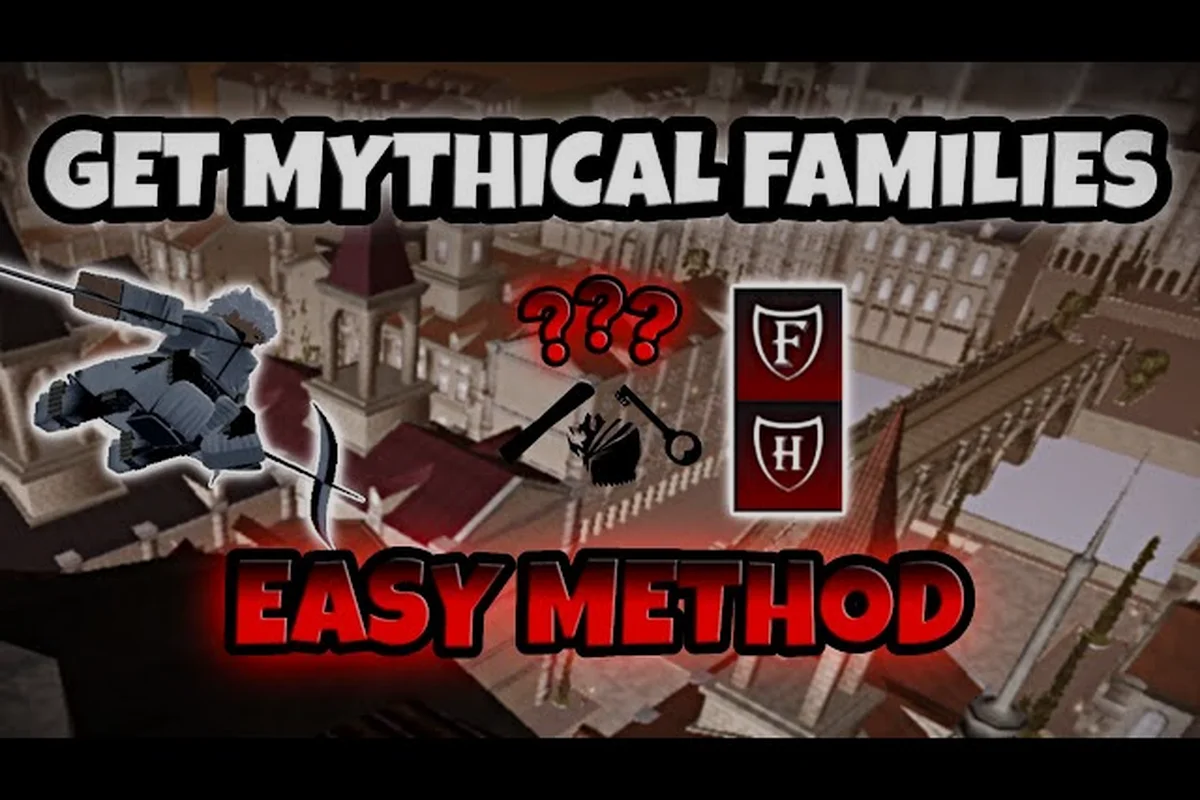
Choosing an Attack on Titan Revolution family is more than a cosmetic decision because each passive modifies the stats behind your Yeager, Ackerman, or Reiss build. Compare the exact passive effects before rerolling, reserve enough Skill Points for a usable family skill, and avoid spending rolls while your loadout is still unfinished; a strong family synergy matters more than an early temporary damage spike.
What Makes a Family Mythic in Attack on Titan Revolution?
A Mythic Family is one of the rarest family identities in the family system. Unlike ordinary gear rolls, the family establishes a passive identity that can influence the build before perks, stats, and family skills are equipped. That makes the roll important from the beginning of a new account.
The official the game page on Roblox confirms that families work as a separate layer beneath the rest of a character’s setup. A strong family does not automatically create a complete build, but it can make certain stat combinations much more valuable.
The rarest result is not simply whichever family has the biggest number. You also need to consider whether its passive supports the perks you have, how it behaves in ordinary combat, and whether it remains useful in raids. A less flashy roll can be the better long-term choice if it fits the account more cleanly.
| Rarity consideration | What it means for a roll | Player decision |
|---|---|---|
| Mythic identity | Grants access to the highest family tier | Prioritize when the passive matches your planned build |
| Passive synergy | Works well with particular stats or skills | Favor synergy over raw rarity |
| Family skills | Adds effects that may be equipped separately | Check the full skill package before rerolling |
| Account stage | May affect whether you can use the family immediately | Read every requirement before committing |
Community clan showcases place Yeager among the headline Mythic rolls, while Ackerman and Reiss are frequently discussed alongside other Legendary or Mythic contenders. These labels are useful for orientation, but community videos are not an official published odds table. When comparing clan results, check the displayed family rarity and passive description together—for example, Yeager’s Mythic status should be weighed against whether its passive complements your equipped perks and family skills, not against the title alone. Ackerman and Reiss may still provide stronger account value if their effects fit your chosen stats, Story Mode progression, or raid setup.
Separate Rarity From Build Value
Treat rarity as the first filter and synergy as the second. A Mythic passive can be weaker for your current setup than a lower-rarity family that directly supports your attack pattern. The goal is not merely to obtain the biggest name attached to the account; it is to obtain a family that produces reliable strength after everything else is equipped.
The family comparison overview is useful for checking where Yeager, Ackerman, Reiss, Fritz, and Helos fall within community discussions. Because community tier charts can change after updates, compare the family passive and skills rather than relying on a label alone.
Yeager, Ackerman, and Reiss Family Comparison
The Attack on Titan Revolution Yeager family is commonly presented as a top-tier result. The Attack on Titan Revolution Yeager family skills also receive frequent attention because a Mythic roll should provide more than a rare name: its active package needs to support the player’s preferred combat style.
The Attack on Titan Revolution Ackerman family is another frequent target for players chasing a powerful clan identity. Looking at the Attack on Titan Revolution Ackerman skills alongside its passive can reveal whether it is a better fit than Yeager for a specific stat spread or training plan.
The Attack on Titan Revolution Reiss family offers another mythic route, and its identity may appeal to players who prefer a different balance of offensive power and passive effects. Detailed coverage of the Reiss family skills and related clan identities can help distinguish a desired passive from the broader family package.
| Family | Community rarity context | Main selection priority | Practical evaluation |
|---|---|---|---|
| Yeager | Frequently discussed as a headline Mythic roll | Confirm that its skills support your chosen build | Strong candidate when synergy is present |
| Ackerman | Often shown in high-end clan showcases | Compare the passive with your stat allocation | Value depends on the complete kit |
| Reiss | Frequently placed in Mythic or Legendary discussions | Check whether the passive rewards your playstyle | Do not treat the name alone as a verdict |
| Fritz | Community discussion places it near Yeager and Helos in Mythic talks | Compare all effects and requirements | Alternative target if it fits better |
| Helos | Included in Mythic-level community discussions | Review its passive and family skills | Another roll worth checking carefully |
No reliable official source provides a confirmed percentage for each Mythic Family. Community footage reports the Yeager roll at roughly 0.1%, while showcases place several Legendary clans near 0.5%. Treat both figures as community estimates rather than guaranteed rates, and do not budget a fixed number of attempts around them.
Check the Entire Package Before Rerolling
A family should be evaluated as a package: passive identity, family skills, and unlock conditions. If the passive is attractive but the associated skills do not fit the build, another family may create more total value. Read the description of every effect, including whether it scales with attack, speed, health, stamina, or another characteristic.
Also confirm whether a family can be equipped immediately. A rare result that cannot be used without additional progression should be compared against a result that supports current raids and training goals. The most efficient reroll decision is not always the one that produces the highest displayed rarity.
Reroll Strategy for Getting a Mythic Family
The practical Attack on Titan Revolution how to get mythic family process starts with deciding what you can reasonably chase. First identify a target family, then calculate a reroll limit, and only then begin rolling. Without a limit, rare outcomes can consume resources that would otherwise support perks, skills, or progression.
| Step | Action | Reason |
|---|---|---|
| 1 | Pick a preferred Mythic family | A target prevents indecisive rerolling |
| 2 | Review the passive and skills | High rarity matters less when the package does not fit |
| 3 | Set a fixed reroll budget | Each attempt should have a clear cost |
| 4 | Roll when the budget allows | Slow, controlled attempts reduce overinvestment |
| 5 | Stop on a strong match | Accept synergy rather than chasing another name |
| 6 | Save an early mythic roll | A usable result can become a permanent base |
This approach also prevents one common mistake: replacing a good result because it is not the single most desirable clan. If the family passive, family skills, and current stat plan work together, keeping that roll often creates more power than continuing to chase a slightly different passive.
Use Luck as a Decision Modifier, Not a Promise
Luck can influence the value of an attempt, but it should not be treated as a guarantee. Players often assume a visibly high Luck value solves the problem of rare family rolls, yet no community source establishes a simple or official conversion from Luck to a guaranteed Mythic chance.
Instead, treat Luck as one layer within a broader plan: use it to improve the conditions around a family roll, not to assume it creates a Mythic result. For example, in a Yeager or Ackerman family attempt, evaluate the roll alongside available resources, passive skills, and the trade-off against a strong non-Mythic family. If Luck does not change the published roll requirements, it should not replace a budget check or a fallback plan, since no verified data establishes a direct Luck-to-Mythic conversion.
-
Budget first: Determine how many rolls you can sustain without weakening the account.
-
Timing second: Use rolling periods when you can focus and check results carefully.
-
Compatibility third: Keep a strong non-Mythic result as a fallback if it fits the build.
-
Outcome fourth: Evaluate the passive, skills, and requirements as soon as the roll completes.
This removes pressure to spend recklessly simply because a Luck bonus is visible. For example, if a Yeager or Ackerman family roll is your goal, decide the maximum number of rolls you can fund before checking the result, because each attempt may consume scarce resources without changing the family’s published requirements. Treat Luck as a modifier to your planning conditions, not as evidence that a Mythic family is guaranteed, and preserve a viable non-Mythic option whenever the roll outcome falls short.
Practical Family Selection for Different Account Stages
New accounts, mid-game players, and raid-focused accounts should not use exactly the same definition of a successful Mythic roll. An early player needs a family that supports immediate training, while a veteran may favor a passive that amplifies an already optimized stat package.
| Account stage | Best selection approach | Families worth examining | Mistake to avoid |
|---|---|---|---|
| New account | Favor usable skills and simple synergy | Yeager, Ackerman, Reiss | Chasing only the rarest name |
| Mid-game | Match the passive to upgraded stats | Yeager, Reiss, Ackerman | Replacing a synergistic roll late |
| Late-game | Prioritize scaling and raid utility | All three major Mythic targets | Ignoring upgrade costs |
| Raid preparation | Test the complete build | Any Mythic with suitable effects | Treating family tier as the whole build |
For mid-game players, the family passive becomes more important because perks and stats now have enough value to amplify it. This is the point where a seemingly small percentage interaction can shape actual performance. Reviewing the current build structure before committing resources helps you identify which passive qualities would actually improve the account.
Save Results That Work Even If They Are Not the Perfect Name
A result with a strong active family kit can remain useful when the account gains better stats. Save one roll immediately after unlocking the family layer, and avoid spending its materials until you understand the passive. This gives you a usable foundation while leaving room to compare a rarer result.
The best practical outcome is therefore not “newest Mythic acquired.” It is a Mythic Family whose passive and skills support the rest of the build without forcing a costly rebuild. That outcome is easier to recognize when you compare each candidate against the same checklist.
Mythic Family Odds, Luck, and Reroll Timing
No official published table confirms Mythic Family probabilities, so claims should remain appropriately cautious. Community experience suggests these rolls are rare, but anecdotal frequency does not establish a reliable mathematical rate. The commonly cited 0.1% Yeager estimate is especially sensitive to how a creator defines the result and sample size.
| Data point | Source type | How to use it |
|---|---|---|
| Yeager near 0.1% | Community-reported estimate | As a rarity warning, not a guaranteed rate |
| Legendary clans near 0.5% | Community showcase estimate | As a rough comparison only |
| Mythic placement of Yeager, Fritz, and Helos | Community ranking discussion | As guidance for which families to inspect |
| Ackerman and Reiss placement | Community showcase discussion | As context for competitive alternatives |
| Luck effect on family rolls | No confirmed exact formula | Avoid promising a guaranteed improvement |
A video such as Mightfreedy’s family ranking can help players see how experienced community members group the families. It should be treated as a community showcase rather than an official statistical reference, especially when it uses tier bands or approximate percentages.
Separate Roll Timing From Upgrade Timing
Rolling more often is not automatically optimal. Each reroll opportunity may compete with other progression needs, so timing should reflect your remaining budget. If you can only make a small number of attempts, choose a quieter session when you can inspect every option without rushing.
The process works best in three stages: define which passive effects or Mythic Families would strengthen the account, such as the Yeager Family for combat-oriented passives, the Ackerman Family for survivability-focused effects, or the Reiss Family for progression and resource-related bonuses. Because exact Mythic drop rates and upgrade costs may change, compare each roll against your saved fallback instead of spending immediately; this protects your gems and leaves room to upgrade a stronger family later.
-
Target: Decide which families and passive effects would improve the account.
-
Attempt: Roll only when your available budget can absorb the result.
-
Evaluation: Compare the new result with your saved fallback before committing resources.
This sequence prevents Luck bonus chasing and makes every roll serve a clear build purpose. It also lets you decide quickly when a result is good enough, which is especially valuable when exact Mythic odds are not publicly documented. For example, if a Yeager Family roll competes with an Ackerman Family option, compare their passive effects against your saved fallback and current gem budget rather than assuming the newest result is superior; a weaker family may also be worth upgrading when its upgrade cost is lower.
Activating and Building Around Your Mythic Result
Once you obtain a Mythic Family, read the passive and skills before spending materials on upgrades. Family skills are equipped separately from perks and memories, according to the official game-page information. If you are unsure about the menu sequence, the family skill equipment guide explains the role of the separate family layer.
Build evaluation should cover four points: the passive scale of the Mythic Family, the practical role of its active effect, its resource efficiency, and its usefulness in raid-style encounters. Compare the family with the character’s existing perks and memories: a Yeager or Ackerman family may deliver strong damage, but it is less valuable if its activation demands disrupt the stamina and cooldown rotation. Confirm that the chosen Reiss option contributes a distinct effect instead of duplicating current gear, then test the complete rotation against a demanding target before committing scarce materials.
| Check | What to look for | Practical result |
|---|---|---|
| Passive scale | Which stats or actions it rewards | Choose perks that feed the passive |
| Active effect | Damage, utility, sustain, or control | Match the skill to the intended fight style |
| Resource efficiency | Stamina, cooldown, or activation demands | Keep rotations realistic in longer fights |
| Raid usefulness | Performance against demanding targets | Avoid a family that only shines in easy content |
Do not assume every skill from the same clan must be equipped. Even a Mythic package can have redundant choices when a character already owns similar effects from other sources. Equip the complementary options and compare performance rather than automatically selecting every available slot.
Test Before Full Investment
Run ordinary training and a representative raid before treating the Mythic family as finalized. The raid guide can provide a suitable test environment for evaluating damage, stamina pressure, and survivability. Record the same encounters before and after the family change so the result is based on observed performance.
If a Mythic family raises damage but breaks your rotation, revisit the build before replacing it. For example, pairing the Yeager family’s stronger burst with an Ackerman or Reiss passive may leave fewer skill slots for the attacks that generate and maintain Pressure Gauge or sustain combo chains. Compare the same encounter with the passive active, then again with the previous rotation, tracking clear damage, stamina usage, and ability uptime. The best family is the one that converts its bonuses into consistent damage without forcing you to skip essential skills; otherwise, the passive remains cosmetic rather than synergistic.
Frequently Asked Questions
What is the fastest way to get a Mythic Family in Attack on Titan Revolution?
There is no confirmed shortcut or guaranteed method. Reroll regularly, maintain a fixed budget, and prioritize a Mythic passive that matches your build. Community odds for individual families are estimates rather than official rates, so the most reliable approach is controlled persistence with a saved fallback roll.
Is the Yeager family better than Ackerman or Reiss?
Not automatically. Yeager is often treated as a headline Mythic target, but Ackerman and Reiss may provide stronger total value for particular stat plans. Compare each passive, its family skills, unlock requirements, and raid performance before deciding which result is worth keeping.
Does Luck guarantee a Mythic Family roll?
No verified formula shows that Luck guarantees a Mythic result. Luck may improve the overall roll experience, but players should not treat it as a promise. Set an attempt limit and save a strong fallback so the account does not depend on one uncertain roll.
Should you keep a Mythic Family even if it does not fit your current build?
Yes, especially if it offers useful skills and could scale with future stats. Keep it as a secure option instead of spending its materials immediately. Compare its passive with the perks you already own, then test whether future upgrades can make it valuable.
How can players avoid wasting resources while chasing a Mythic Family?
Track each attempt and define a fixed budget before rolling. Save one compatible result as a fallback, reroll only when resources are available, and stop when the passive supports your planned build. This approach preserves progress while keeping the search focused.