
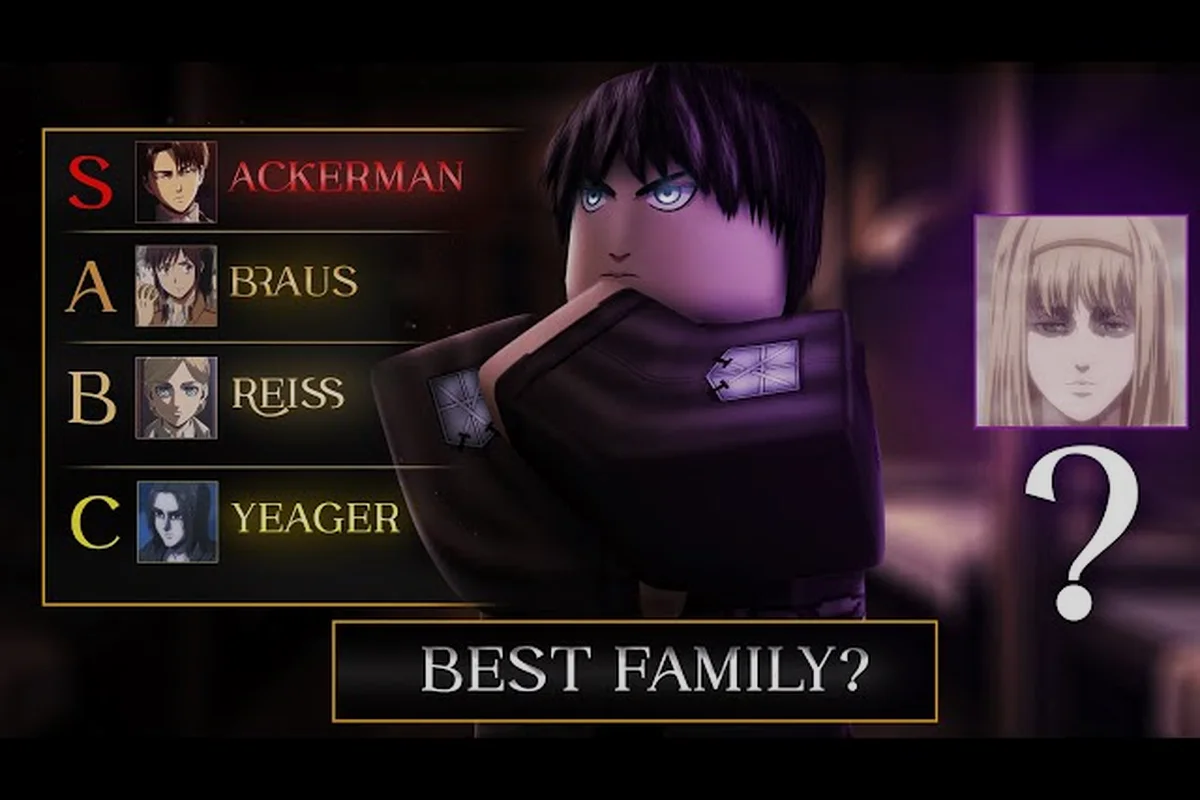
This Attack on Titan Revolution family comparison shows which clan passives suit combat styles, progression goals, and resource limits. A family matters because its passive identity shapes every stat layer above it, so the right pick can improve a build more than a marginal perk upgrade.
Family Comparison and Core Values
Families are the rarity layer beneath a character’s perks, memories, and other stat layers. Each clan has a passive identity plus a separate set of family skills, meaning a roll determines the direction of a build before additional bonuses are applied. This is the central idea behind an Attack on Titan Revolution family comparison: the strongest-looking family is only useful when its passive works with the character and the content you play.
The official page on Roblox describes the family system as a distinct equipment layer. A poor passive can drag down an otherwise strong stat package, while an excellent passive makes a good build feel much stronger without requiring every other choice to be perfect.
| Comparison factor | What it changes | Why it matters |
|---|---|---|
| Passive identity | The main effect of the clan | Defines the build’s strongest interaction |
| Rarity | Potential ceiling | Rarer families may offer more powerful effects |
| Skill compatibility | How well family skills support the passive | High rarity cannot rescue a mismatched kit |
| Reroll cost | How easily the choice can be changed | Influences whether an early roll should be kept |
| Build role | Combat style and preferred activity | Helps players select for waves, raids, or shifters |
Reading the Passive Before the Rarity
Rarity is an important signal, but it should not be the only filter in an Attack on Titan Revolution family ranking. A rare passive that adds damage without supporting the character’s main attack pattern may deliver less practical value than a slightly lower-tier passive that strengthens the right stat. Players should compare the passive, active family skills, and intended equipment as one package.
For an Attack on Titan Revolution family comparison, treat rarity as one input rather than a verdict: a lower-rarity passive that directly raises Strength, Speed, or Skill for the character’s main attack pattern can outperform a rarer roll with no clear combat payoff. For example, a clan that improves damage output should be weighed against a Strength-focused passive that boosts the actual attack stat, while the clan’s active family skills determine whether that gain translates into more pressure, control, or survival in combat.
-
Passive fit: Confirm that the clan improves the stat or mechanic the character already uses.
-
Skill synergy: Check whether the family skills create extra pressure, duration, mobility, or survivability.
-
Rarity: Use it as a tiebreaker when two families support the build equally well.
-
Resource cost: Keep a valuable roll only when replacing it would cost more than the expected benefit.
Why a Strong Family Still Needs Good Stats
A family passive multiplies or redirects the stats layered above it. If the character’s underlying attack speed, strength, stamina, or gear is weak, a strong passive may have less room to work. For that reason, this family comparison focuses on function rather than treating the clan name as a complete build recommendation.
The broader relationship between clans and perks is covered in does family matter in Attack on Titan Revolution. That distinction matters when a family seems impressive in a showcase but does not improve the stats that actually determine your damage, movement, or consistency.
Family Ranking Bands by Passive Value
A useful Attack on Titan Revolution family ranking should be grouped into bands rather than presented as a rigid one-to-22 list. Community rankings often separate exceptional mythic rolls, legendary performers, dependable choices, and weaker options. That structure reflects how the system is actually used: a player can keep a personal favorite even when another player ranks it differently.
Community showcases place Yeager alongside Fritz and Helos in mythic discussions. The frequently cited estimate for Yeager is approximately 0.1 percent, but that number comes from community reports rather than an official published table. Likewise, videos that place Ackerman, Reiss, and Shiki in a legendary band often mention an approximate 0.5 percent rate. These are community-reported estimates, not confirmed drop percentages.
| Community band | Families commonly discussed | Practical interpretation |
|---|---|---|
| Mythic discussion | Yeager, Fritz, Helos | Highest perceived ceiling; verify the exact passive before committing |
| Legendary showcase | Ackerman, Reiss, Shiki | Strong competitive options with broader discussion around them |
| Solid mid-to-upper tier | Varies by showcase and current build | Often the best balance of performance and reroll cost |
| Lower-value families | Varies by active skills and character | May be replaced if resources allow |
Mythic and Legendary Discussion Families
The most visible families are not automatically the best choices for every character. Yeager’s mythic positioning creates strong pull in clan showcases, while Fritz and Helos also appear frequently in high-end community rankings. Players should compare what each passive boosts, the character’s attack pattern, and the family skills that unlock alongside it.
For instance, a clan that improves a frequently used stat can outperform one with a dramatic but situational passive. A slow build that rarely benefits from its effect may need a different family than a fast melee character. This distinction keeps the Attack on Titan Revolution family ranking useful even when community videos disagree on the exact order.
Mid-Tier Value and Reroll Flexibility
A mid-tier family can remain worthwhile when its passive fits the build and the player cannot justify another spin. Since every reroll consumes limited resources, expected value matters more than the headline rarity of the current roll. A family that works reliably across several game modes may be more valuable than a top-tier roll designed for one narrow situation.
Players considering a change should review the current Attack on Titan Revolution family reroll cost before acting. That helps prevent a common mistake: spinning repeatedly because a result looks less prestigious while ignoring the actual cost and the strength of the current passive.
| Current family situation | Sensible action |
|---|---|
| Passive fits the main build | Keep it unless a clearly better roll is available |
| Passive has little impact | Consider rerolling if the cost is low |
| Passive supports secondary stats | Test it in real activities before replacing it |
| Rarity is high but synergy is poor | Do not value rarity over function |
| Resources are needed elsewhere | Keep a functional family and save the spin |
Clan Showcase Traits and Family Luck
The concept of family luck describes the uncertainty surrounding a family spin, but it should not be treated as a guaranteed system mechanic unless the developers publish such a rule. There is no verified evidence in the available sources that luck increases a particular family’s chance by a fixed amount. Players should therefore base decisions on observed results, the current passive, and resource cost rather than unsupported drop-rate folklore.
A clan showcase is most useful when it demonstrates the entire package. Look for the family’s passive, its active skills, the character carrying it, the stat distribution, and the mode used for testing. A damage clip with an unexplained setup can create the misleading impression that rarity alone caused the performance.
What a Reliable Family Showcase Should Reveal
A strong showcase answers five questions by documenting the family in a controlled comparison rather than presenting an unsupported tier label. Include the equipped family, the character and gear used, the passive’s exact effect, the encounter type, and any temporary buffs active during the test; this separation matters because a family spin, raid result, or shifter encounter can otherwise make a family appear stronger than its passive warrants.
-
Which family is equipped?
-
Which character and gear are being used?
-
What does the passive improve?
-
Was the result achieved in standard waves, a raid, or a shifter encounter?
-
How much of the performance came from the family rather than temporary buffs?
The verified gameplay video I Ranked EVERY Family In Attack On Titan Revolution by Mightfreedy illustrates the community preference for tier bands rather than a universal numerical order. It is useful as a comparison resource, though each player should still test the relevant passive in their own setup.
Mythic Rolls Versus Practical Upgrade Paths
A mythic family can produce an excellent account, but the family spin cost is only one part of the upgrade path. Character level, gear, perks, memories, and training investments also shape performance. That is why a community-reported 0.1 percent Yeager estimate attracts attention without proving that Yeager is always the correct pick.
Family luck should guide persistence, not gambling assumptions. Spend the resources needed for ordinary progression first, and treat an exceptional family as a high-value bonus when it arrives. If the current family supports your build, continuing to chase another roll can delay more meaningful upgrades without a guaranteed payoff.
| Factor | Mythic roll | Functional mid-tier family |
|---|---|---|
| Immediate excitement | Very high | Moderate |
| Long-term build compatibility | Unknown until tested | Usually easier to explain |
| Reroll pressure | High because of rarity | Depends on passive value |
| Resource efficiency | Excellent if strongly synergistic | Better when resources are scarce |
| Recommended response | Test immediately, then protect the roll | Keep if it improves core stats |
Family Reset and Spin Decisions
A family reset should follow a repeatable process rather than a reaction to the newest rare clan. Start by identifying the passive, then compare its value against the current family, and finally calculate whether the expected improvement justifies the cost. Reset value depends on what changes in the build, not simply on the name of the next result.
Community reports suggest that families can be rerolled, but the exact interface and available reset resources should be checked in the current game. This guide does not assume that every reset method is unlimited, free, or available for all accounts. Players should confirm the latest cost and requirements before committing.
A Five-Step Reset Checklist
-
Identify the current passive. Write down the stat or mechanic it improves.
-
Compare the current and prospective roles. The replacement should improve a frequently used part of the build.
-
Check the family skills. A strong passive still matters less if the additional skills do not support the character.
-
Review the reroll cost. Compare the likely benefit with gems or other resources needed for progression.
-
Test before another spin. If the new family works, give it time in waves, raids, and shifter battles.
Family Spin Budgeting
Players often lose more resources by reacting impulsively than by choosing a family that is mildly below the ideal tier. Divide available spins into an early exploration budget and a protected endgame budget. Use the first group to identify a solid family, then reserve the remainder for a specific target rather than repeatedly rerolling without criteria.
For progression planning, how to get gems in Attack on Titan Revolution can help connect family decisions with wider resource goals. The key is to treat the family spin as one progression expense, not an isolated activity that receives unlimited attention.
| Reset condition | Priority | Reason |
|---|---|---|
| Family passive does not support any equipped skill | High | The roll offers little lasting value |
| Current family works but another is only slightly better | Low | Marginal gains may not justify the cost |
| A target family appears | Protect it | Replace it with a clearly stronger result |
| Resources are needed for gear or skills | Save spins | Other upgrades may improve the account more |
| Test results are still unclear | Wait | Modes can reveal a passive’s real limitations |
Choosing Families for Waves, Raids, and Shifters
The best family depends on the activity. A clan that feels excellent during normal waves may not be the safest choice for a raid, while a flexible defensive passive may feel less exciting during damage checks but provide greater consistency in longer encounters. This makes role-based selection more useful than chasing a single universally dominant clan.
Before testing a family in difficult content, prepare the rest of the character. The Attack on Titan Revolution solo raid guide covers encounter preparation, while this comparison focuses on how the passive should fit the activity once the character is ready.
Waves
Waves reward repeatable offense, resource efficiency, and the ability to sustain a clear attack rhythm. Prioritize a passive that improves the character’s primary damage stat, attack speed, stamina, or a frequently triggered skill effect. A passive that works only after several special actions may feel inconsistent when enemies appear quickly.
Raids
Raid preparation rewards survivability and dependable damage. The ideal passive either strengthens the stat needed to meet the encounter’s damage threshold or improves the support skill that keeps the character active. A team can compensate for weaker individual stats, but the passive still needs to contribute something meaningful.
| Activity | Passive priority | Secondary priority | Avoid prioritizing |
|---|---|---|---|
| Waves | Core damage or attack speed | Stamina or trigger synergy | A passive that rarely activates |
| Raids | Reliable damage or survivability | Buff uptime and resource control | A high-rarity effect with narrow use |
| Shifters | Fast adaptation and consistent offense | Mobility or defensive coverage | A slow, highly conditional passive |
Shifters and Boss Encounters
Shifters test whether a family remains useful when the encounter changes. Faster characters need sustained offense, while players who lack mobility may gain more from a passive that improves survivability. The same family can feel excellent against one boss and ordinary against another because the encounter determines which stats and effects matter.
Do not rely on damage previews alone. Record clear-time changes, missed opportunities, stamina management, and whether the passive activated during the decisive moments. This approach gives the family spin a measurable outcome rather than an emotional reaction to a single clip.
The Best Family Myth
The strongest community candidates include Yeager, Fritz, Helos, Ackerman, Reiss, and Shiki, but their order depends on the build and community criteria. This article does not claim that one of them wins every comparison. The better conclusion is that top-rarity clans are candidates, while build synergy is the deciding factor.
Family Comparison Checklist for a Complete Build
A successful family comparison ends with a specific decision: keep, test, or replace. Write down the passive, identify the main character stat, review the family skills, and assign a test mode. This prevents the family spin from becoming disconnected from the rest of the character.
Before You Keep the Roll
Before keeping a new family, verify the following: compare the candidate passive with the current character’s actual stat priorities, then check whether its family skills reinforce the build’s normal skill rotation instead of creating an unused branch. Use a controlled family spin or reset test on a nonessential setup, and record how the new passive performs in difficult mode before committing rare materials; a strong-looking family rank or clan showcase can still be a poor match for the character you already use.
-
The passive improves a stat used by the current character.
-
The family skills support the character’s main skill rotation.
-
The build remains effective without relying on one rare effect.
-
The result has been tested in a difficult mode.
-
The reroll resources have a clear purpose in the progression plan.
If one of these checks fails, keep the family only as a temporary option. A rare label does not compensate for poor synergy, and the cost of a reset may be smaller than the cost of investing gear and training into an ineffective passive.
After You Reset
After changing the family, give the new configuration time to settle. Compare it with the previous roll using the same wave, raid, or shifter encounter. If possible, keep the gear and stats constant so the passive is the primary changed variable.
| Evaluation step | Question to answer |
|---|---|
| Passive check | Does the effect improve the character’s primary stat? |
| Rotation check | Do the family skills fit the normal skill rotation? |
| Mode check | Does the family perform in the intended activity? |
| Resource check | Was the reset cost justified by the improvement? |
| Long-term check | Would you keep this result without another perfect roll? |
A family is not the same thing as a complete character. Players can improve their overall performance through a stronger perk package, and the Attack on Titan Revolution perk tier list can help identify complementary choices. The best family should make the rest of the build work better, not disguise a weak stat allocation.
Frequently Asked Questions
Which family is best in Attack on Titan Revolution?
No single family is best for every character. Yeager, Fritz, Helos, Ackerman, Reiss, and Shiki frequently appear in strong community showcases, but the best passive depends on the character’s stats, skill rotation, and activity. Test a family in waves, raids, or shifter battles before treating rarity as the deciding factor.
How much does family luck affect a family spin?
Available community information does not confirm a fixed luck multiplier or guaranteed improvement rate for a family spin. Treat luck as an informal description of rare results, not a rule you can plan around. Protect an exceptional roll after it arrives, and avoid spending scarce resources on repeated attempts without a defined target.
Should players reset a rare family with a weak passive?
Rarity alone is not enough to keep a family if its passive does not support the build. Compare the current passive with your character’s main stats, review the active family skills, and test the character in a relevant mode. A reset makes sense when the expected improvement is meaningful and the reroll cost fits your wider progression plan.
What is the best Attack on Titan Revolution family ranking for beginners?
Beginners often benefit more from a straightforward passive that improves a frequently used stat than from a complex top-rarity effect. Community tier videos are useful starting points, but individual performance depends on your character and gear. Keep the first workable family, learn the skill rotation, and delay repeated spins until you understand your account’s needs.
Can one family handle both raids and shifter battles?
A well-matched family can support both activities, especially when its passive improves core damage, stamina, or frequently used skills. Some effects are more valuable in long raids, while others shine during fast shifter encounters. Testing the same build across both modes reveals whether the passive is versatile or situation-dependent.